Biometric Identity Verification: The New Standard for Trust in an Era of AI-Powered Fraud
Biometric Identity Verification: The New Standard for Trust in an Era of AI-Powered Fraud
Your password can be stolen. Your face cannot.
There comes a moment when every organization realizes that traditional identity verification is no longer enough.
For some, that moment arrives during a compliance audit. For others, it comes after a fraud incident that exposes weaknesses in their onboarding process. And for many businesses today, it begins with a simple realization: the methods that once protected identities are now being outpaced by the technologies designed to exploit them.
Not long ago, verifying someone's identity meant checking a password, validating a government-issued document, or sending a one-time passcode to a registered device. These methods were considered sufficient because the barriers to fraud were relatively high. Today, those barriers have collapsed.
A fraudster no longer needs to steal a wallet, intercept a text message, or compromise an email account. With publicly available artificial intelligence tools, criminals can generate realistic faces, create synthetic identities, manipulate identity documents, and produce convincing deepfake videos capable of bypassing weak verification systems. What once required sophisticated criminal networks can now be achieved with software available online.
This is not a future threat. It is the reality businesses face today.
As organizations accelerate digital transformation, remote onboarding, and online customer acquisition, the challenge of proving identity has become one of the most critical security, compliance, and operational concerns of the modern era. This is why biometric identity verification has emerged as the new standard for organizations that cannot afford to get identity wrong.
From financial institutions and healthcare providers to government agencies and global employers, businesses are increasingly turning to biometrics to establish trust, reduce fraud, strengthen compliance, and create seamless digital experiences.
The question is no longer whether biometric verification is valuable. The question is whether your current verification process is capable of defending against the threats that exist today.
Contents
- What Is Biometric Identity Verification?.
- How Does Biometric Identity Verification Work?.
- Why Traditional Identity Verification Is No Longer Enough.
- Facial Recognition Verification: The Foundation of Modern Digital Identity.
- Why Liveness Detection Technology Has Become Essential
- Understanding Presentation Attack Detection.
- Fingerprint Identity Verification: The Proven Biometric Standard.
- Can Biometrics Be Faked or Spoofed?.
- Deepfake Fraud Prevention: The New Frontier of Identity Security.
- Remote Identity Proofing and the Future of Digital Onboarding.
- Why Biometric Authentication for Businesses Is Becoming Essential
- The Future of Identity Verification Is Already Here.
- Frequently Asked Questions.
What Is Biometric Identity Verification?
At its core, biometric identity verification is the process of confirming an individual's identity using unique biological characteristics rather than credentials they know or documents they possess.
Traditional verification methods depend on information that can be stolen, shared, guessed, or forged. Passwords can be compromised. Security questions can be researched. Identity documents can be manipulated. Even one-time passcodes are vulnerable to interception and social engineering attacks.
Biometrics operate differently because they rely on characteristics that are inherently linked to the individual. Facial features, fingerprints, iris patterns, and other biometric markers are unique to each person and significantly more difficult to replicate than traditional credentials.
When an individual attempts to verify their identity, the system captures a biometric sample and compares it against a trusted reference source. This reference may be an identity document, a previously enrolled biometric template, or a verified identity record. If the biometric characteristics match within an acceptable confidence threshold, the identity is verified.
The result is a verification process that is simultaneously more secure and more convenient than traditional alternatives.
How Does Biometric Identity Verification Work?
One of the most common questions businesses ask is: how does biometric identity verification work?
Although implementations vary across industries and providers, modern biometric verification typically follows a structured process designed to establish both identity and authenticity.
The journey often begins with document verification. A user uploads or scans a government-issued identity document such as a passport, driver's license, or national identity card. Advanced verification systems analyze the document's security features, detect signs of tampering, and confirm authenticity.
The next stage involves biometric capture. Depending on the use case, the individual may provide a facial scan, selfie, fingerprint scan, or another biometric sample. Sophisticated algorithms analyze the biometric characteristics and convert them into mathematical templates rather than storing simple images.
The system then performs a comparison between the biometric sample and the trusted reference source. If a match is established, the individual's identity is verified.
However, modern biometric systems must answer a second, equally important question — is the biometric sample being presented by a real, live human being? This is where technologies such as facial recognition verification, liveness detection technology, and presentation attack detection become essential.
Why Traditional Identity Verification Is No Longer Enough
The digital economy has transformed identity into one of the most valuable assets a criminal can target.
Organizations increasingly conduct business remotely, onboard customers online, and hire employees without ever meeting them in person. While this shift creates tremendous convenience, it also creates significant opportunities for identity fraud.
Cybercriminals have become remarkably effective at exploiting traditional verification methods. Password databases are routinely compromised. Social engineering attacks continue to evolve. Stolen identity documents circulate through criminal marketplaces. Synthetic identities combine real and fabricated information to create entirely fictitious individuals.
Perhaps most concerning is the rise of generative artificial intelligence. Modern AI systems can generate realistic faces that have never existed, create convincing identity documents, and produce deepfake videos capable of impersonating legitimate individuals. These capabilities have fundamentally altered the fraud landscape.
Businesses that continue relying solely on passwords, document checks, or one-time passcodes are increasingly exposed to threats that these methods were never designed to address. Biometric identity verification helps close this gap by introducing a stronger and more reliable proof of identity.
Facial Recognition Verification: The Foundation of Modern Digital Identity
Among all biometric modalities, facial recognition verification has become the most widely adopted solution for digital identity verification.
Its popularity stems from a simple reality: nearly every individual already possesses the hardware required to use it. Smartphones, tablets, laptops, and connected devices include cameras capable of capturing high-quality facial images, making facial recognition both accessible and scalable.
Modern facial recognition systems do far more than compare photographs. Advanced algorithms analyze hundreds of unique facial characteristics, including the relative positioning of facial landmarks, geometric relationships, contours, and structural features, and transform these measurements into mathematical representations that can be compared with remarkable accuracy.
Unlike older systems that struggled with lighting variations, aging, or camera angles, contemporary facial recognition technologies leverage artificial intelligence to adapt to real-world conditions. This allows organizations to verify identities remotely while maintaining high levels of accuracy and security.
For businesses conducting remote onboarding, facial recognition verification has become one of the most effective methods of establishing trust without requiring physical interaction.
Why Liveness Detection Technology Has Become Essential
As facial recognition systems became more widespread, fraudsters quickly began searching for ways to exploit them.
Early-generation systems could sometimes be deceived using printed photographs, digital displays, or recorded videos. This challenge led to one of the most important innovations in modern identity security: liveness detection technology.
Liveness detection determines whether the biometric sample being presented originates from a real, live human being rather than a spoofing attempt. In other words, before verifying identity, the system must verify human presence.
Modern liveness detection technology analyzes a wide range of signals that are difficult or impossible for fraudulent representations to reproduce, including facial depth, texture patterns, light reflections, involuntary micro-movements, and physiological characteristics associated with living tissue.
Two primary approaches dominate the industry:
Active liveness requires users to perform actions such as blinking, smiling, or turning their heads. These interactions help confirm that a live person is present during verification.
Passive liveness operates silently in the background, analyzing biometric characteristics without requiring explicit user actions. For legitimate users, the experience feels seamless. For fraudsters attempting to present photographs, videos, or manipulated content, the technology creates a significant barrier.
As digital fraud continues to evolve, liveness detection has become a critical component of any effective biometric verification strategy.
Understanding Presentation Attack Detection
One of the most important concepts in modern biometric security is Presentation Attack Detection (PAD).
A presentation attack occurs when an individual attempts to deceive a biometric system using a fake representation of a legitimate user's biometric traits printed photographs, video replays, digital screen displays, masks, artificial fingerprints, and increasingly sophisticated deepfake content.
Presentation attack detection is specifically designed to identify and stop these attacks. Rather than simply determining whether two biometric samples match, PAD evaluates whether the presented biometric sample itself is authentic.
The most advanced solutions are tested against international standards such as ISO/IEC 30107-3 and undergo independent evaluation to assess their resistance to spoofing attacks. For organizations selecting a biometric verification provider, strong presentation attack detection capabilities are no longer optional they are a fundamental requirement.
In a world where synthetic media can be generated within minutes, the ability to distinguish between a genuine human being and a fraudulent representation has become one of the defining characteristics of a trustworthy identity verification solution.
Fingerprint Identity Verification: The Proven Biometric Standard
While facial recognition dominates remote onboarding, fingerprint identity verification remains one of the most trusted biometric technologies ever developed.
For more than a century, fingerprints have been used to establish identity because of their uniqueness and permanence. No two individuals share identical fingerprint patterns, making them highly reliable identifiers.
Modern fingerprint verification systems analyze intricate ridge structures, minutiae points, and other microscopic characteristics to create highly accurate biometric templates. Today's technologies extend far beyond traditional fingerprint scanners advanced systems incorporate ultrasonic imaging and multispectral scanning techniques capable of capturing both surface and subsurface fingerprint characteristics, significantly improving resistance to spoofing attempts while maintaining exceptional accuracy.
Fingerprint verification continues to play a vital role in workforce access control, government identity programs, healthcare environments, financial services, and high-security facilities where strong identity assurance is required.
Can Biometrics Be Faked or Spoofed?
One of the most frequently searched questions surrounding biometrics is: can biometrics be faked or spoofed? The honest answer is yes but the context matters.
Just as no cybersecurity solution is completely immune to attack, biometric systems can face spoofing attempts. Fraudsters may attempt to use photographs, masks, recorded videos, artificial fingerprints, or AI-generated content to deceive verification systems.
The more important question is whether the verification solution has been designed to detect and defeat these attacks.
Modern biometric identity verification platforms incorporate multiple defensive layers facial recognition verification, liveness detection technology, presentation attack detection, behavioral analysis, device intelligence, and fraud monitoring capabilities. Rather than relying on a single verification factor, the most effective systems evaluate numerous signals simultaneously. This layered approach dramatically increases the difficulty of successful impersonation attempts.
Organizations should not ask whether biometrics can theoretically be spoofed. They should ask whether their chosen solution includes the protections necessary to defend against today's fraud techniques.
Deepfake Fraud Prevention: The New Frontier of Identity Security
Few technologies have transformed the fraud landscape as dramatically as generative artificial intelligence.
Deepfake tools can now create highly convincing videos, images, and voice recordings that mimic real individuals. These technologies have lowered the barriers to identity fraud and introduced entirely new attack vectors.
Fraudsters increasingly use deepfakes to bypass onboarding processes, create synthetic identities, access financial services, and conduct impersonation attacks. Traditional verification methods often struggle to detect these sophisticated forms of deception.
This is why deepfake fraud prevention has become a major focus across the identity verification industry. Leading verification providers are responding by integrating advanced AI detection systems, injection attack monitoring, liveness detection, presentation attack detection, behavioral intelligence, and device-level analysis into their verification frameworks.
The future of identity verification will increasingly involve artificial intelligence defending against artificial intelligence. Organizations that fail to adapt risk exposing themselves to a rapidly evolving threat environment where fraudulent identities can be generated faster than ever before.
Remote Identity Proofing and the Future of Digital Onboarding
The rise of remote work, digital banking, telemedicine, and online services has accelerated demand for remote identity proofing.
Remote identity proofing enables organizations to establish trust without requiring in-person interactions. Through a combination of document authentication, biometric verification, facial recognition, liveness detection, and fraud analysis, businesses can verify identities entirely online.
This capability has transformed industries worldwide. Financial institutions can onboard customers remotely. Employers can verify candidate identities during recruitment. Government agencies can deliver services digitally. Healthcare providers can authenticate patients without requiring physical visits.
For legitimate users, the process is faster and more convenient. For organizations, it delivers stronger security and broader reach. As digital transformation continues, remote identity proofing will become an increasingly important pillar of identity assurance strategies.
Why Biometric Authentication for Businesses Is Becoming Essential
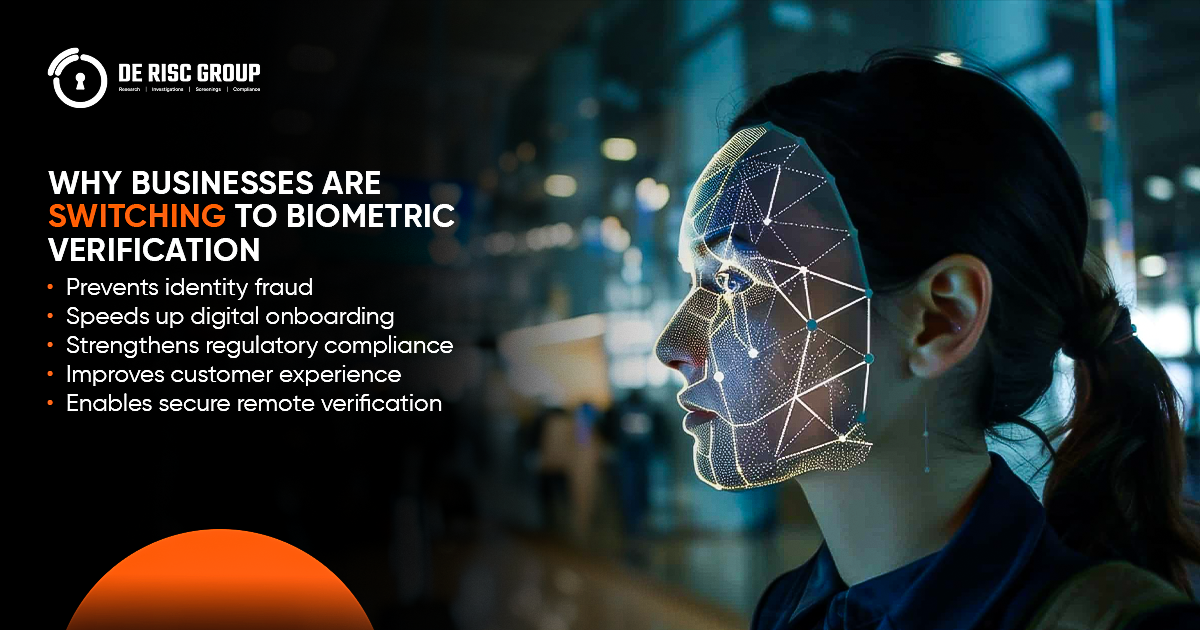
The adoption of biometric authentication for businesses is being driven by more than security concerns alone.
Organizations increasingly recognize that effective identity verification improves customer experiences, streamlines onboarding, reduces operational costs, and supports regulatory compliance. Unlike passwords, biometrics cannot be forgotten. Unlike identity documents, they cannot easily be transferred or shared. Unlike security questions, they are not vulnerable to social engineering.
The result is a verification process that is often both faster and more secure than traditional alternatives. For businesses, this translates into higher onboarding completion rates, reduced fraud losses, stronger compliance outcomes, and improved trust among customers, employees, and stakeholders.
As identity becomes a central component of digital interactions, biometric authentication is evolving from a competitive advantage into a business necessity.
The Future of Identity Verification Is Already Here
The challenge facing businesses today is not simply verifying identities. It is verifying identities in an environment where artificial intelligence can generate realistic faces, create synthetic identities, manipulate documents, and automate fraud at unprecedented scale.
For years, organizations relied on passwords, security questions, and physical documents as proof of identity. Those methods were built for a different era one where impersonation required significant effort and fraudsters faced higher barriers to entry. That era is over.
Today, trust must be established through stronger, more intelligent methods. Biometric identity verification has emerged as one of the most effective ways to meet that challenge because it focuses on something inherently tied to the individual rather than something that can be forgotten, stolen, shared, or forged.
When combined with facial recognition verification, liveness detection technology, presentation attack detection, deepfake fraud prevention, and remote identity proofing, biometric systems provide businesses with a powerful framework for establishing trust at every stage of the user journey from onboarding new customers and employees to securing ongoing access to systems and services.
As fraud techniques continue to evolve, the organizations that succeed will not be those that simply react to new threats. They will be the ones that proactively invest in technologies capable of identifying genuine users while stopping increasingly sophisticated attacks before they can cause harm.
Ultimately, biometric identity verification is about more than security. It is about confidence. Confidence that the individual accessing your platform is real. Confidence that your onboarding process can withstand modern fraud attempts. Confidence that your organization is prepared for a future where digital trust is one of the most valuable assets a business can possess.
Because in a world where anyone can generate a fake identity with artificial intelligence, the ability to verify a real one becomes a competitive advantage.
Frequently Asked Questions
What is biometric identity verification?
Biometric identity verification is the process of confirming an individual's identity using unique biological characteristics such as facial features, fingerprints, iris patterns, or voice characteristics. Unlike passwords or identity documents, biometric traits are inherently linked to the individual, making them a more secure form of identity verification.
How does biometric identity verification work?
Biometric identity verification works by capturing a biometric sample such as a facial scan or fingerprint and comparing it against a trusted reference source, such as a government-issued identity document or a previously enrolled biometric record. Modern systems often incorporate liveness detection technology and fraud analysis to ensure the biometric sample originates from a real person.
What is facial recognition verification?
Facial recognition verification is a biometric process that analyzes and compares unique facial characteristics to confirm a person's identity. Advanced systems use artificial intelligence to evaluate facial geometry, landmarks, and structural features while accounting for variations in lighting, age, and camera angles.
Can biometrics be faked or spoofed?
While fraudsters may attempt to spoof biometric systems using photographs, videos, masks, or AI-generated content, modern biometric verification solutions incorporate multiple layers of protection including liveness detection, presentation attack detection, behavioral analysis, and device intelligence to identify and prevent these attacks.
How does biometric verification help prevent deepfake fraud?
Biometric verification helps combat deepfake fraud by combining facial recognition, liveness detection, presentation attack detection, and advanced fraud analysis techniques. These technologies can identify signs of synthetic media, manipulated video streams, and AI-generated impersonation attempts that may bypass traditional verification methods.
What is remote identity proofing?
Remote identity proofing is the process of verifying an individual's identity entirely online without requiring an in-person interaction. It typically combines document verification, biometric authentication, facial recognition verification, and liveness detection technology to establish trust remotely.
Why is biometric authentication important for businesses?
Biometric authentication for businesses helps reduce identity fraud, strengthen regulatory compliance, improve onboarding experiences, enhance security, and streamline access management. As organizations increasingly operate in digital environments, biometrics provide a scalable and reliable method of establishing trust.
Is biometric identity verification secure?
When implemented correctly using advanced fraud prevention controls, biometric identity verification is one of the most secure forms of identity assurance available today. The strongest solutions combine biometric matching with liveness detection, anti-spoofing protections, document verification, and continuous fraud monitoring.